Maggottonian Pentagon
|
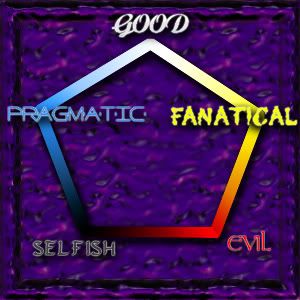
The Maggottonian Pentagon is an alignment system used to provide a shorthand summary of a person's behavioral, moral, and ethical tendencies. Created by the Maggottonians, an a-moral race of pan/multidimensional entities with an extremely violent libertarian streak whom Yaijinden encountered in his wider travels, it was coined as an attempt to balance personal attitudes and actual actions while forgoing inherent moral judgements on behavior.
Definition of Terms
Purely Good individuals prioritize the welfare of others over their own in any and all circumstances, and would consider the suffering of even a single innocent to be unacceptable. Pragmatic persons are more fluid with their ethical calculus and are seldom fixed to any given priority or viewpoint, evaluating individual decisions by their current long-term and moment-to-moment interests. Selfish persons prioritize their own well-being and benefit first, and are often indifferent to the needs of others save how those needs interact with their own. Evil persons measure their own well-being and interests expressly by the domination and subjugation of others without regard to one's own benefit. Fanatical individuals live by a code of conduct and measure themselves by how well (or poorly) they adhere to the code's tenets.
Traditional Use
When used by the Maggottonians, individuals are described as a dot or a short line segment scribed on the perimeter of the pentagon. Most individuals exist as line segments; the closer a person is to an angle of the pentagon, the more often their behavior is motivated by the beliefs described by that angle. Only truly static creatures, such as very long-lived gods or other transmortal consciousnesses, exist as single points. Persons with true split personalities (Dr. Jekyll and Mr. Hyde types) are listed by the alignment of both personalities.
The arrangement of the pentagram and the limited acceptable range of general behaviors suggests the underlying philosophy of its creators. Good individuals do not act for themselves, nor do they act in ways that would hurt others. Fanatical persons do not vary from the behavior prescribed moral/ethical code regardless of circumstance, and thus are extremely unlikely to vary their judgements based on circumstances or benefit themselves for their own sake. Evil persons always see the infliction of suffering as an appropriate answer to a situation, and neither help others nor engage in ethical re-evaluation. Selfishness places the 'I' above the 'we' in most circumstances, and eschews the hardline idealism of the fanatic as a hindrance to bettering oneself. Pure Pragmatism's flexibility precludes unfailing adherence to external codes, and sees unmitigated evil as needless and pointless.
SubSen Adaptation
While suitable for the Maggottonians, the traditional application does not easily describe more complex personalities. The most-often suggested amendment is a scoring of each of the five tendencies. The lowest score of zero indicates that the individual never even considers behaving in such a fashion (extremely rare in anything but saints, monsters, and automotons), and the highest score of five indicates that all actions the individual takes are filtered through that part of their paradigm (again, extremely rare in anything but saints, monsters, and automatons).
Application
By way of example, among the Suburban Senshi, using the Traditional viewpoint, Yaijinden evaluates the Suburban Senshi:
Jedite is very strongly Selfish, with tendencies towards Evil. He relishes and is constantly looking to personal power, and enjoys prodding people where he knows it will hurt. When wanton cruelty will hurt his objectives, though, he can and will exercise restraint.
In her youth, Haruka was Fanatical-Good: dedicated to duty and willing to sacrifice her comrades in order to achieve her goals, but also believing she was helping out others in doing so. Nowadays, she has mellowed out quite a bit and become Pragmatic by means of laziness and a well-earned sense of retirement.
Much like her wife, Michiru was Fanatical-Good in youth. She has become more Pragmatic-Selfish in her adulthood, concerned chiefly with the maintenance of her dignity and honor.
Rei, Makoto, and Minako are collectively Good-Pragmatic. They have retained their sense of obligation to the community, but are willing to occasionally look the other way from what is best to what has their interest at the moment.
Chibiusa and Elios are both solely Selfish. While they has no interest in hurting other people, she also has no interest in anything that does not make her look or feel better about herself.
Among the Xadium-Sunrise clan, Gemini and Sakura are chiefly Good, concerned with the well-being of friends, family, and those who cannot protect themselves. Xadium himself is Pragmatic, leaning Good (the influence of having lived with heroes in the past several years). Noriko is generally Good, but has reflexes belonging to her much more Fanatic previous incarnations.
